
Vol. 3 No. 4 (2026): Emerging Frontiers and Intelligent Solutions in Information Technology, Cybersecurity, and Artificial Intelligence
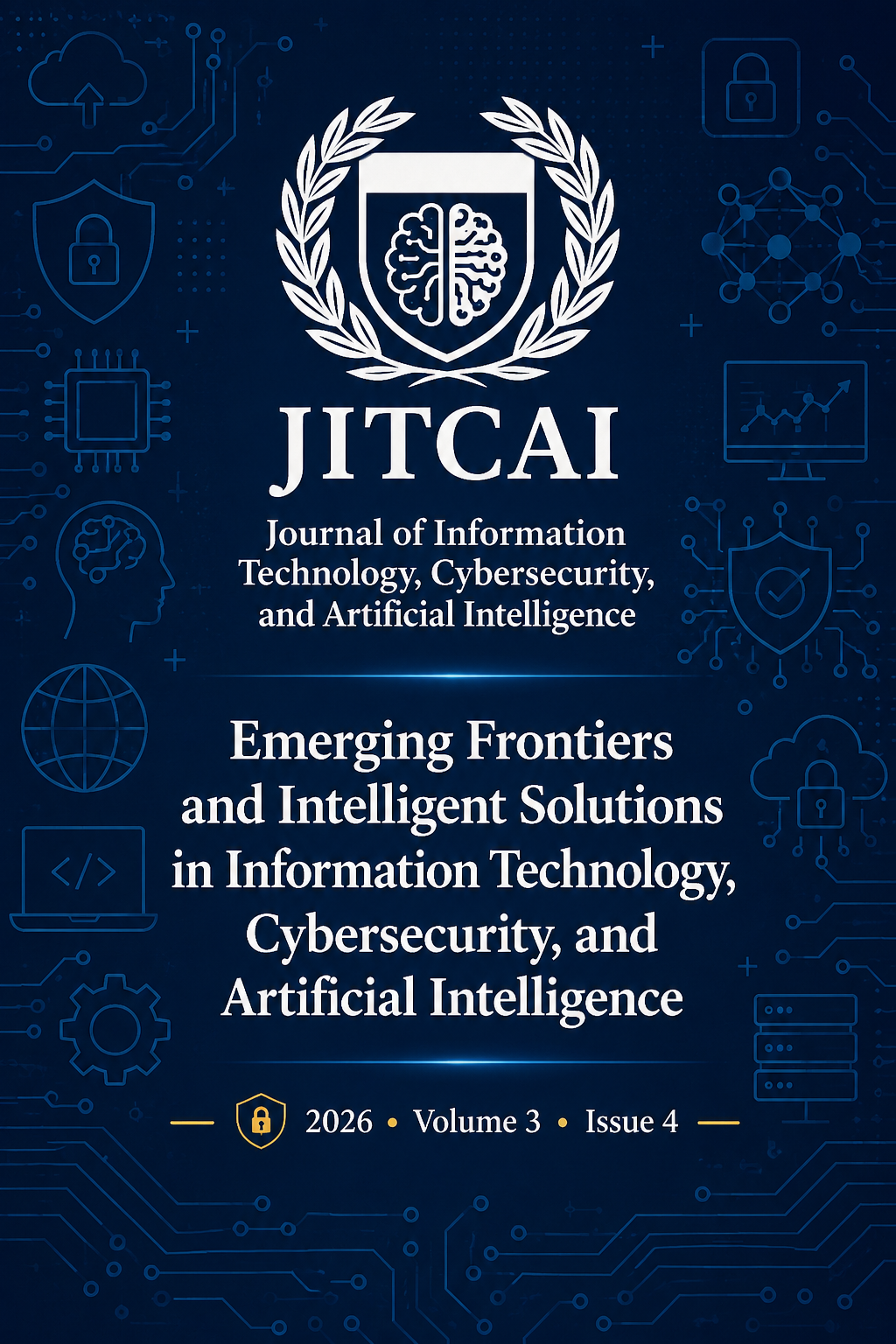
					View Vol. 3 No. 4 (2026): Emerging Frontiers and Intelligent Solutions in Information Technology, Cybersecurity, and Artificial Intelligence

Volume 3, Issue 4 of the Journal of Information Technology, Cybersecurity, and Artificial Intelligence (JITCAI) showcases cutting-edge research addressing the rapid evolution of digital technologies and the growing convergence of artificial intelligence, cybersecurity, and information systems. This issue presents innovative methodologies, practical applications, and emerging solutions that contribute to the advancement of secure, intelligent, and resilient computing environments.

The articles featured in this issue examine a wide range of topics, including artificial intelligence and machine learning, cybersecurity frameworks, cloud and edge computing, software engineering, digital forensics, data analytics, privacy-preserving technologies, intelligent automation, and emerging computing paradigms. Collectively, these contributions demonstrate how modern technologies are transforming industries, strengthening cyber resilience, and enabling data-driven decision-making across diverse sectors.

As digital transformation accelerates worldwide, this issue emphasizes the importance of interdisciplinary collaboration and responsible innovation in addressing contemporary technological challenges. The published works provide valuable insights for researchers, educators, practitioners, policymakers, and graduate students seeking to advance knowledge and develop practical solutions in information technology, cybersecurity, and artificial intelligence.

JITCAI remains committed to publishing rigorous, peer-reviewed, open-access research that fosters scientific excellence, encourages global collaboration, and supports the development of secure, ethical, and intelligent technologies for the benefit of society.

Published: 07/31/2026

Articles

  • AI Enabled Risk Management in International Logistics Networks

    Purnima Tripura (Author)
    1-14
    DOI: https://doi.org/10.70715/jitcai.2026.v3.i4.081
  • Mental Health Outcomes Among University Students: Identifying Risk Factors and Preventive Strategies

    Dr Emon Hasan, Akash Banerjee, MD Hasib Hossain (Author)
    85-95
    DOI: https://doi.org/10.70715/jitcai.2026.v3.i4.094
  • Artificial Intelligence and Blockchain as Determinants of Healthcare Data Security Transformation

    OLUSEGUN GBOLADE (Author)
    30-47
    DOI: https://doi.org/10.70715/jitcai.2026.v3.i4.083
  • When Everyone Has the Same AI: Rethinking Startup Competitive Advantage in the Age of Generative AI

    Mwita Joseph James Wanyancha (Author)
    15-29
    DOI: https://doi.org/10.70715/jitcai.2026.v3.i4.085
  • PH-AIDE: A Multi-Modal Explainable AI Framework for ICU Risk Stratification and Evidence-Based Public Health Policy Design

    Safkat Mustakim Nirjash, Sharmin Akter, Shakim Ahamed, Dr Emon Hasan (Author)
    48-66
    DOI: https://doi.org/10.70715/jitcai.2026.v3.i4.087
  • Toward Transparent Intrusion Detection Systems: An Explainable Ai Approach For Network Security

    Clinton Amponsah, Bernard Kyiewu, Andrew Oppong-Asante, Maclean Nimoh Antwi (Author)
    135-148
    DOI: https://doi.org/10.70715/jitcai.2026.v3.i4.079
  • When Does AI Capability Convert to Advantage? A Complementarity-Gated Framework for Startups in Resource-Constrained Economies

    Mwita Wanyancha, Moureen Lembris Mollel (Author)
    121-134
    DOI: https://doi.org/10.70715/jitcai.2026.v3.i4.091
  • AI Builder Integration and Implementation: A Qualitative Study on Microsoft Power Platform

    Pullaiah Chowdary Vutla, Triveni Yenugu (Author)
    143-159
    DOI: https://doi.org/10.70715/jitcai.2026.v3.i4.080
  • A Distributed Multi-Agent Artificial Intelligence Framework for Proactive Cybersecurity Risk Detection and Enterprise Business Analytics

    ali hassan (Author)
    96-120
    DOI: https://doi.org/10.70715/jitcai.2026.v3.i4.093